
The price displayed per page on a Carrefour kiosk represents only a fraction of the actual cost of printing. Due to local price variability, the random availability of equipment, and the time spent in-store, we observe a significant gap between the theoretical price and what the service actually costs the requester.
Actual total cost of printing at Carrefour compared to a specialized shop
Comparing a printing service in a supermarket with that of a brand like Bureau Vallée requires going beyond the unit price per page. At Bureau Vallée, the pricing grid is explicitly described as indicative: the final price varies depending on the store and available services. We recommend applying the same understanding to Carrefour kiosks, where conditions differ from one point of sale to another.
The first hidden cost is waiting and handling time. At a self-service kiosk, transferring a file via USB stick, setting the format, and making the payment easily takes around ten minutes, more if the interface has issues or if the kiosk is busy. In a specialized shop, an operator handles the file directly, which reduces the risk of layout errors.
A detailed guide on printing document prices at Carrefour helps frame the average prices observed, but the actual price always depends on the store visited.
The second hidden cost is the actual availability of the service in-store. Printing kiosks are not present in all Carrefour locations, and when they are, they may be out of service, under maintenance, or low on supplies. In a specialized shop, printing is the core business: the equipment is continuously maintained. This reliability factor changes the calculation as soon as there is an urgent need.
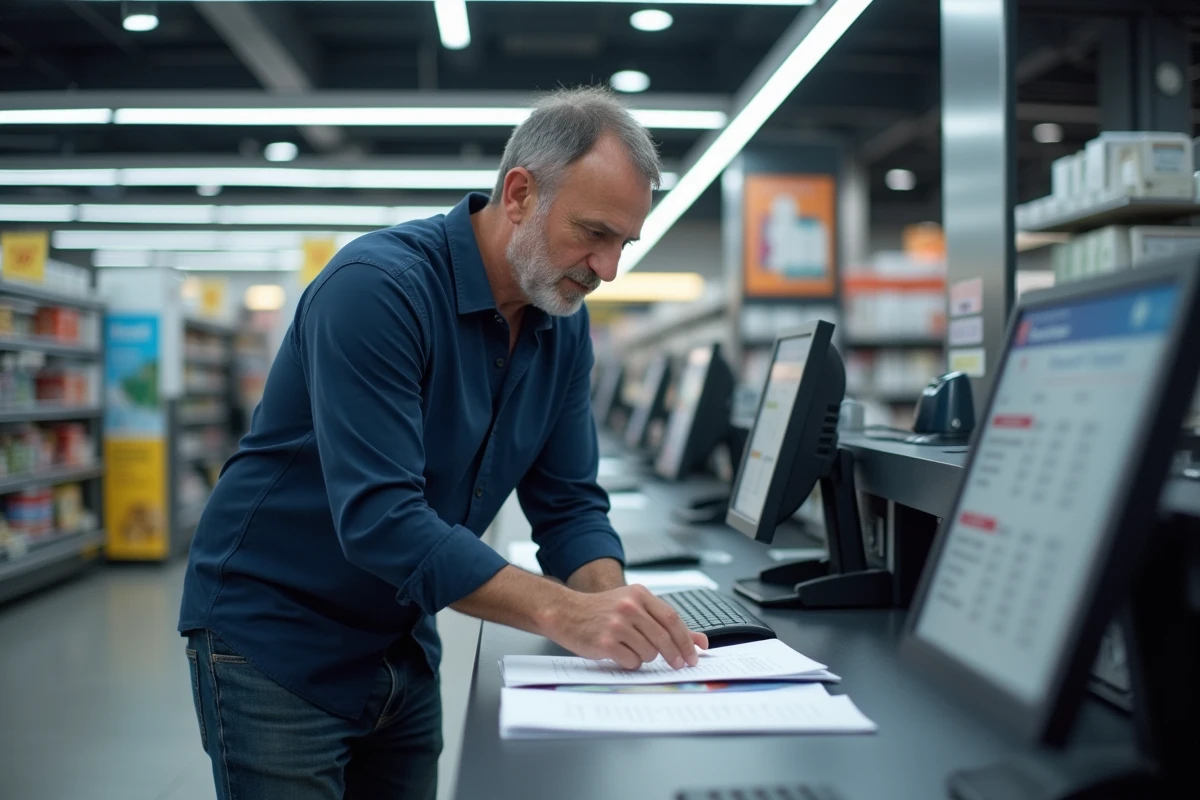
Local price variations: why the price differs from one Carrefour to another
The pricing of printing services at Carrefour is not centralized in the same way as a product price on the shelf. Each store manages its own kiosks, sometimes through a third-party provider. The result: the price of a black and white page can vary significantly between two Carrefour locations in the same area.
This variability can be explained by several factors:
- The type of kiosk installed (brand, generation, color capabilities or black and white only) determines the pricing grid applied locally.
- The volume of service usage influences the conditions negotiated with the technical provider, which is reflected in the displayed price.
- Additional fees (double-sided printing, sizes larger than A4, finishing) are not always offered or charged at the same rate.
Before heading out, we recommend calling the store to confirm the availability of the service and the current price. No reliable national grid covers the entire Carrefour network for printing.
Black and white or color printing: decide based on page volume
The choice between black and white and color is not just an aesthetic question. For small volumes (a few pages), the unit price difference between the two modes remains moderate. However, as the volume increases, color printing multiplies the cost by three to five compared to black and white, according to the grids observed at Bureau Vallée.
For an administrative file, a CV, or a contract, black and white is sufficient in almost all cases. Switching to color is justified for visual presentations, marketing materials, or photos. We observe that many users print in color by default, without checking the kiosk settings, which unnecessarily inflates the bill.
Setting tip for self-service kiosks
Before starting the print job, always check two settings: the color mode (switch to black and white if the document allows) and double-sided printing. Double-sided printing halves the number of sheets, reducing both cost and paper volume. Not all kiosks automatically offer this option: some require manually flipping the sheets.
USB file and accepted formats: prepare your file to avoid failures
The primary cause of wasted time at a Carrefour kiosk is an incompatible or poorly prepared file. Kiosks generally accept PDF format, sometimes JPEG for images. Word or PowerPoint files are not always natively supported, which requires conversion before heading out.
We recommend following this preparation:
- Convert any document to PDF before copying it to the USB stick. This ensures that the layout will be preserved, without relying on specific fonts or software.
- Check that the USB stick is formatted in FAT32, the most universally recognized format by kiosks.
- Name the file simply, without special characters or accents in the name, to avoid reading errors.
- Test opening the file on another device before leaving to confirm that the PDF is not corrupted.
A well-prepared file reduces the time spent at the kiosk to just a few minutes. A poorly formatted file can block printing and necessitate a second trip.
Print quality: what supermarket kiosks actually produce
Self-service kiosks use standard laser printers. The quality achieved is suitable for text and simple graphics. For prints requiring high resolution or photographic rendering, a specialized shop will have large format inkjet printers or professional machines that deliver a significantly superior result.
The difference is especially noticeable in solid colors and gradients. On a CV or an administrative document, it remains negligible. On a portfolio or creative book, it justifies the extra cost of a professional printer.
The final calculation therefore depends on the type of document, the volume, and the urgency. For a few pages in black and white without time constraints, a Carrefour kiosk remains an economical option. As soon as the need becomes more complex (volume, color, finishing, guaranteed reliability), resorting to a specialized service often proves more cost-effective once time and travel are factored into the calculation.