
Between a low-cost wired model and a high-end battery-powered hedge trimmer, the price gap can range from simple to quintuple. The weight, blade length, noise level, and battery life vary just as much. For a well-maintained garden, the choice relies less on the brand than on the suitability between the tool’s technical characteristics and the actual nature of the hedge to be trimmed.
Noise Pollution and Electric Hedge Trimmers: An Underestimated Criterion in Urban Areas
Online comparisons rank hedge trimmers by power or blade length. Few place noise at the top of the list. Field reports tell a different story.
Bruitparif, the Noise Observatory in Île-de-France, published a survey in 2024 highlighting an increase in complaints related to noise from powered garden tools. The organization explicitly recommends using electric hedge trimmers, whether wired or battery-operated, to limit neighborhood conflicts.
A gas-powered hedge trimmer generates a significantly higher noise level than an electric model. In a housing development or condominium with a garden, this difference is not trivial: municipal regulations govern the hours of use for powered tools, and the loudest models reduce the usable time frame.
An electric device, being quieter, allows for work early in the morning or late in the day without causing friction with neighbors. The buying guides available on taille-haie-electrique.com detail these differences in noise levels between motor types.

Wired or Battery: Comparative Table of Key Features
The choice between a wired hedge trimmer and a cordless model structures the entire purchasing decision. Here are the concrete differences to consider.
| Criterion | Wired Hedge Trimmer | Battery-Powered Hedge Trimmer |
|---|---|---|
| Battery Life | Unlimited (plugged in) | Variable depending on battery capacity |
| Weight | Generally lighter (no built-in battery) | Heavier at equal cutting capacity |
| Range | Limited by extension cord | Free, without cable |
| Motor Power | Stable and constant | Decreases at the end of charge on some models |
| Noise Level | Low | Low to moderate |
| Entry Price | The lowest on the market | Higher (includes battery and charger) |
| Maintenance | Minimal | Management of battery charging cycle |
For a small garden with a hedge close to a socket, the wired option remains the most economical and lightweight choice. The battery model gains an advantage as soon as the hedge exceeds about fifteen meters or runs along a property line far from any electrical source.
Blade Length and Cutting Capacity: Adapting the Tool to the Hedge
The blade length determines the width of the cut in one pass. A short blade (around 45 cm) offers more maneuverability for low hedges or rounded shapes. A long blade (65 cm and more) speeds up work on linear and tall hedges but increases weight and reduces precision in corners.
The cutting capacity, expressed by the spacing of the teeth, is as important as the blade length. A wide spacing allows for cutting thicker branches. For a well-maintained hedge of thuja or laurel, a moderate spacing is sufficient. For a wild hedge with woody branches, aim for a larger spacing.
- Young or regularly trimmed hedge (privet, boxwood): short to medium blade, reduced spacing, lightweight for maximum comfort of use.
- Dense and old hedge (palm laurel, photinia): medium to long blade, wide spacing, powerful motor to avoid blockages.
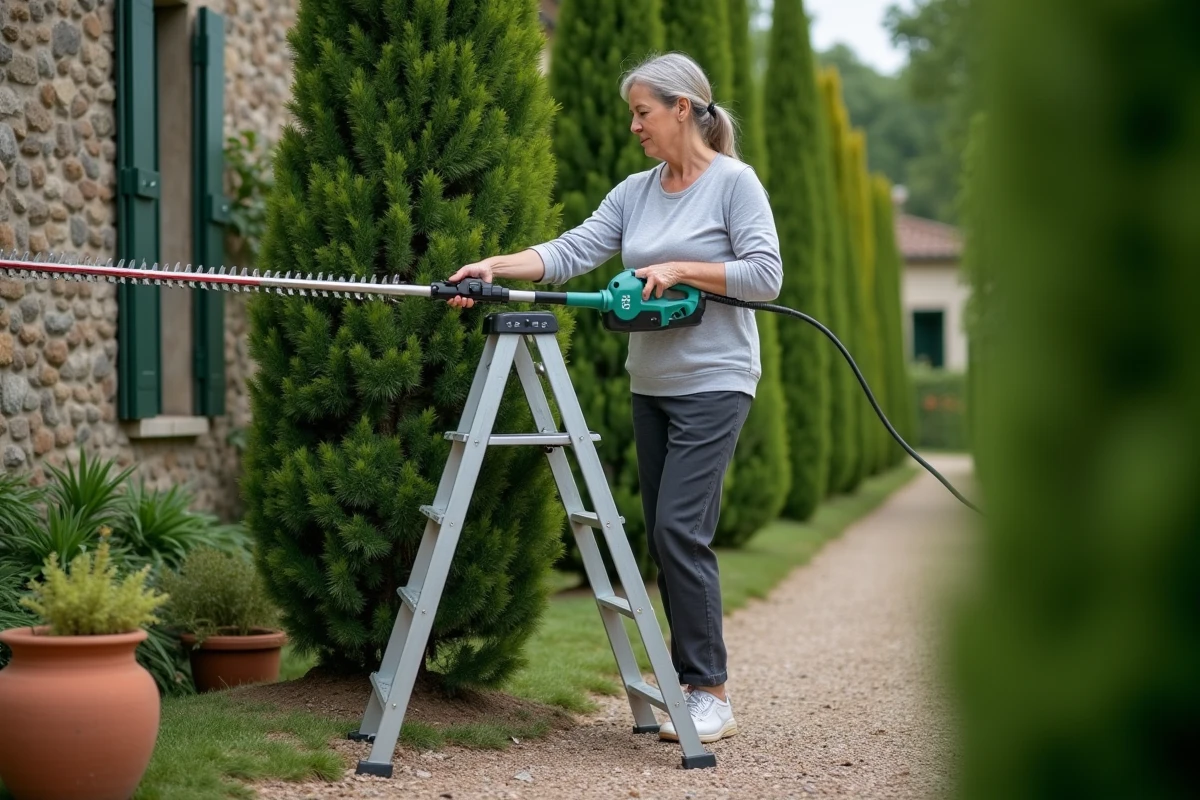
- Tall or overhanging hedge: consider a telescopic or pole model, which allows for working at height without a ladder, at the cost of increased weight.
Rotating Handle and Ergonomics
Trimming a hedge for an hour puts strain on the arms, shoulders, and wrists. A rotating rear handle changes the working angle and reduces wrist twisting during vertical cuts. A well-balanced hedge trimmer with an adjustable handle significantly reduces fatigue during long sessions.
Total weight remains the main ergonomic factor. Beyond a certain threshold, even good balance does not compensate for mass. For users who trim alone and for long periods, it is better to sacrifice a few centimeters of blade length for increased lightness.
Shared Use Batteries: The Multi-Tool Logic Changes the Game
Since 2024, Husqvarna and Stihl, among others, have been developing ranges of electric hedge trimmers compatible with shared-use batteries integrated into multi-tool platforms. The same battery pack powers the hedge trimmer, blower, chainsaw, and brush cutter.
This approach changes the economic calculation. The entry cost of a battery-powered hedge trimmer seems high if the battery is dedicated to a single tool. However, if that same battery works with three or four devices from the same manufacturer, the actual cost per tool decreases significantly.
Before purchasing an isolated hedge trimmer, check the battery compatibility with the rest of the tools you own or plan to acquire. Switching from one brand to another mid-way means repurchasing batteries and chargers, an additional cost that weighs more than the price difference between two competing models.
Legal Obligations: Trimming Hedges Along Public Roads
The Climate and Resilience Law (Law No. 2021-1104 of August 22, 2021) and its implementing decrees strengthen the obligations for pruning and trimming hedges along public roads and near power lines. Enedis publishes a dedicated fact sheet, updated in February 2025, detailing the minimum distances to be respected.
These constraints influence the choice of tool. Trimming at height along a road or near an electrical network requires a maneuverable, lightweight device, preferably on a pole to maintain a safe distance. A battery model, without a cable that could snag, is essential in this context.
The French Office for Biodiversity also recommends avoiding hedge trimming from March 15 to July 31, during the bird nesting period. Planning your two annual trimming sessions outside of this window protects wildlife and concentrates tool use over a few weeks each year, which also guides the budget: a device used four to six times a year does not need to be sized like a professional tool.