The grammar in 6th grade relies on precise vocabulary: grammatical classes, functions in the sentence, agreements. Printable exercises that incorporate a game mechanic (riddles, rankings, sentences to reconstruct) allow these concepts to be worked on differently than with a textbook. The program for cycle 3, updated for the start of the 2025 school year, sets the expectations for grammatical analysis for this last year before cycle 4.
Check the compliance of a playful exercise with the cycle 3 program
Before printing a worksheet found online, one point deserves attention: the new French program for cycle 3 applies in 6th grade since 2025. Worksheets labeled “compliant with the program” without a date of update may refer to an earlier version.
The ministerial guide “The Grammar of French from CP to 6th grade” details the expected grammatical vocabulary and the progression of concepts. Comparing a playful worksheet with this document allows for quick identification of any discrepancies: an exercise that introduces the relative subordinate clause before the concept of noun complement is acquired, for example, does not follow the recommended progression.
To select grammar exercises for 6th grade that are suitable, it is therefore useful to cross-reference the content of the worksheet with the benchmarks in the guide rather than relying on a simple mention on the download page.
Grammatical classes in 6th grade: three formats of printable games that work
The identification of grammatical classes (noun, verb, adjective, determiner, pronoun, adverb, preposition, conjunction) forms the foundation of grammatical analysis in 6th grade. Classic worksheets ask students to underline or circle. Playful formats add a constraint that forces the student to think differently.
The timed column sorting
A mixed list of words, a column table (one for each grammatical class), a timer. The student sorts each word into the correct column within a limited time. This format is well-suited for printing: an A4 sheet is sufficient, and the correction can be on the back.
The interest lies in the rapid repetition. Classifying the word “quickly” as an adverb becomes a reflex when done several times under time pressure.
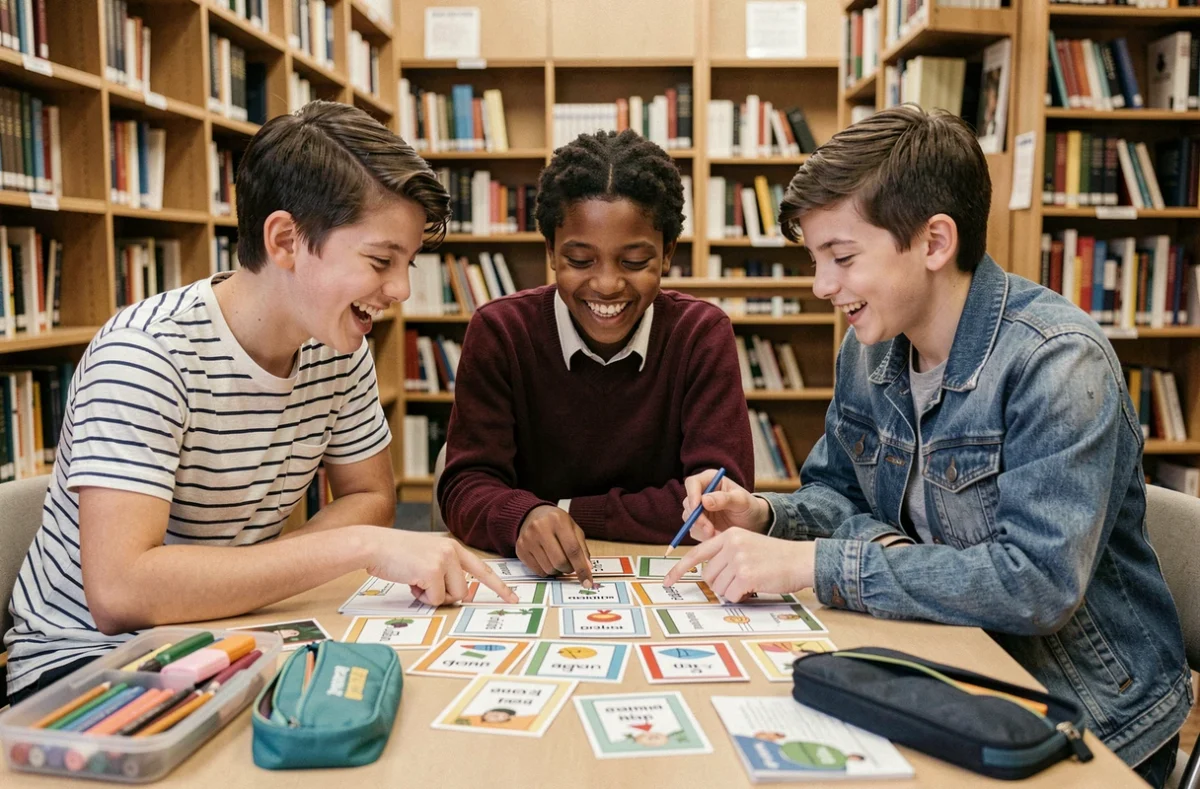
The cut-out card game
Each card has a word. The student draws a card and must name the grammatical class before placing the card on the corresponding pile. To be printed on paper with a sufficiently dense weight so that the words do not show through on the back.
This format also works in pairs: one student draws, the other validates or corrects. The oral dimension adds a layer of learning absent from traditional written exercises.
The mystery sentence to reconstruct
Cut-out word labels, a clue like “build a sentence that contains a proper noun, two adjectives, and an adverb.” The student must select the right words from a larger set, then form a correct sentence. This format simultaneously works on the recognition of classes and syntax.
Grammatical functions: printable exercises with integrated correction
Functions in the sentence (subject, direct object, indirect object, circumstantial complement, subject attribute) often pose more difficulties than grammatical classes. The student must understand the role of the word in a specific sentence, not just its nature.
An effective playful format for printing: the flap worksheet. The sentence is at the top, the question (“What is the direct object?”) in the middle, and the answer is hidden under a folded flap. The student can self-correct without needing a separate answer key.
For circumstantial complements, substitution exercises work well in a game format:
- A starting sentence is given with a circumstantial complement underlined (place, time, manner)
- The student must replace this complement with another of the same type, drawn from a printed list of options
- The constraint: the new sentence must remain grammatically correct and make sense, which requires checking the category of the complement
This type of exercise avoids the pitfall of simple passive identification. Manipulating groups of words in the sentence anchors the notion of function more durably than repetitive underlining.
Limits of playful activities and criteria for choosing a printable worksheet
The fun aspect of an exercise does not guarantee its pedagogical effectiveness. A study on the implementation of learning through play in primary education reported progress among students but specified that the progress cannot be attributed to a specific game in the absence of a comparison group and because the activities varied from session to session.
In other words, play can accompany learning, but it does not replace the explicit structuring of the concept. A playful worksheet without a reminder of the rule or without detailed correction risks remaining mere entertainment.
Some concrete criteria for evaluating a worksheet before printing it:
- The instructions must be understandable without the help of an adult (student autonomy)
- A reminder of the rule or a short definition must be included on the worksheet, not on a separate document that the student will not go and fetch
- The correction must be accessible (on the back, flap, or a separate PDF file) to allow for self-correction
- The format must fit on an A4 page, single-sided or double-sided, without requiring complex cutting that needs precision scissors
The accessibility of the support also matters. A report from the IGÉSR recommends making learning accessibility a principle in its own right. In practice, for a printed worksheet, this means a readable font, sufficient character size, and short instructions.
The choice of a printable grammar exercise for 6th grade ultimately boils down to three questions: does the concept being worked on correspond to the current program, does the game mechanic genuinely require the student to apply the rule, and does the support allow for autonomous correction. A worksheet that ticks these three boxes is worth more than a visually appealing but grammatically vague activity.